Photographing a Lunar Eclipse from Start to Finish
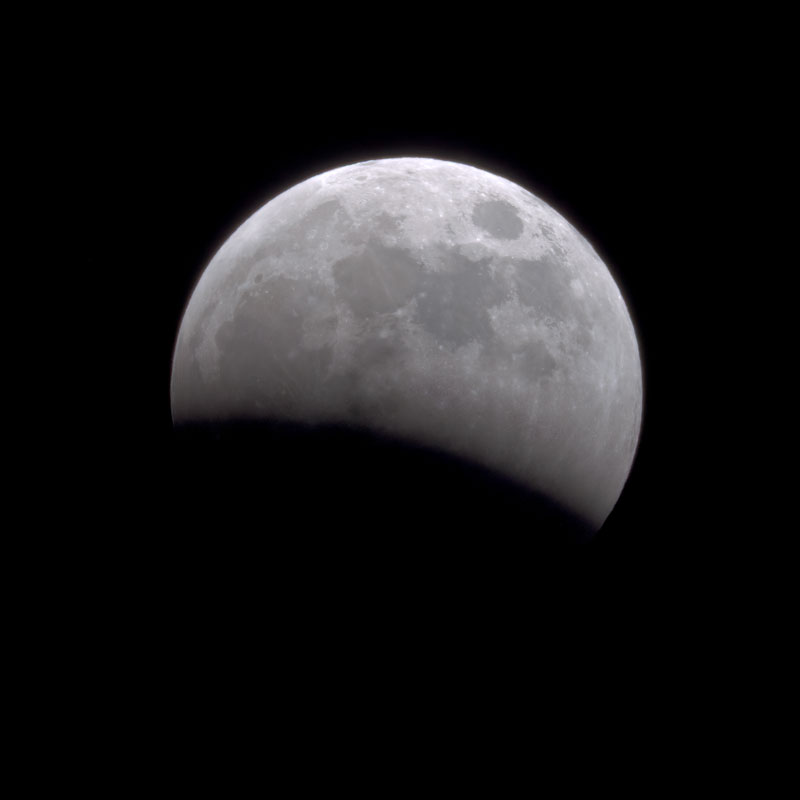
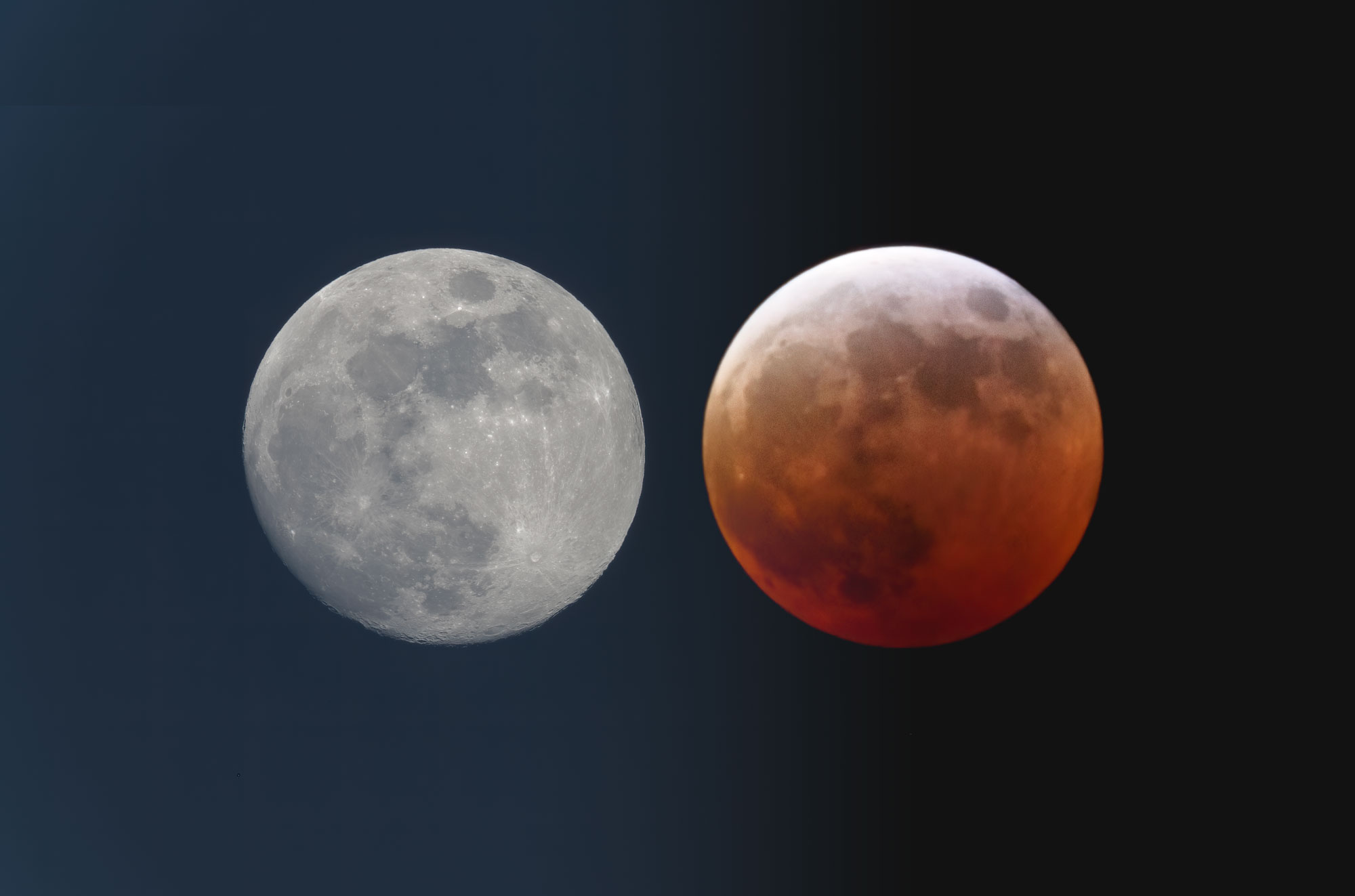
Most lunar eclipse coverage shows a red moon. But it’s not only red. Over the span of a couple of hours, the Earth moves between the Sun and the Moon, causing the Earth’s shadow to slowly cross the lunar surface.
The bright full Moon we’re used to seeing when there’s no eclipse begins to darken from one side, eventually sitting behind the Earth in its shadow, turning red. That stage is called totality. The Moon turns red because sunlight is bending through Earth’s atmosphere which filters out blue light. That transition from full moon to totality to moonset and sunrise is what I want to capture – at 3 focal lengths and techniques.
Capturing the lunar eclipse at each phase can be quite challenging. Attempting all three simultaneously is a true test of my technical skills. Thankfully, this isn’t my first lunar eclipse. On my first attempt, I captured the totality and umbra/pre-umbra phases. But…while some images turned out crisp and clean, others were soft. I learned a lot.
I encourage you to attempt lots of regular Moon and lunar eclipse captures. Due to the wide range of brightness and the Moon’s quick movement across the sky, I find it to be one of the more challenging night sky objects to capture well.
My lunar eclipse photography plan: the gear
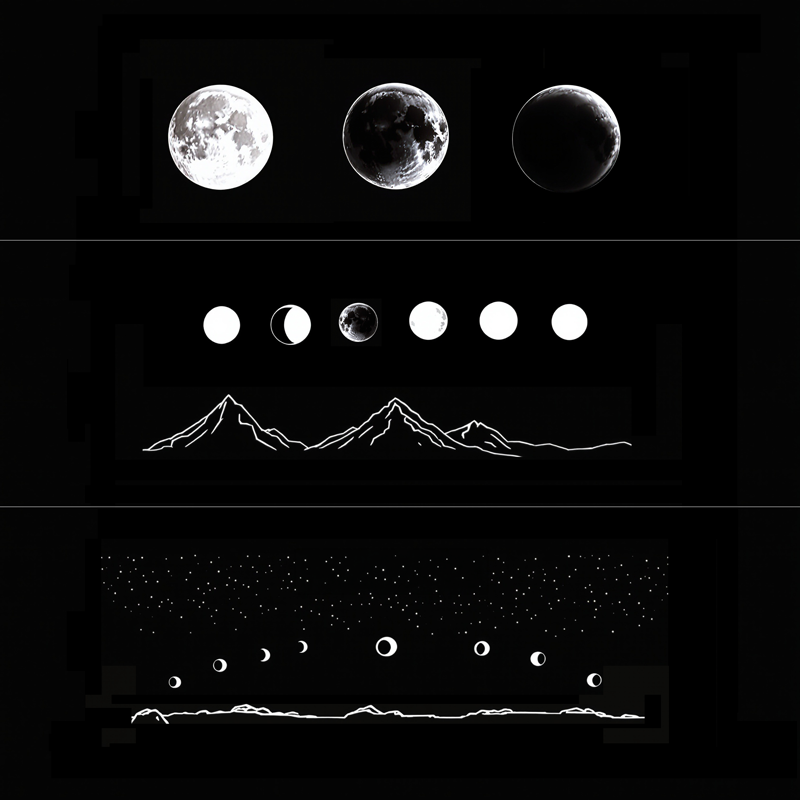
The Moon’s position and progression through each phase of the lunar eclipse event is what directs my gear choices. Instead of chasing the Moon with one camera and swapping lenses all night, I’d rather build three dedicated setups so each one can do a specific job.
That way I’m not breaking down gear during critical moments (think dust and lost time), and I’m not compromising the composition when the light changes too quickly to swap a lens. My goal isn’t redundancy, but coverage.
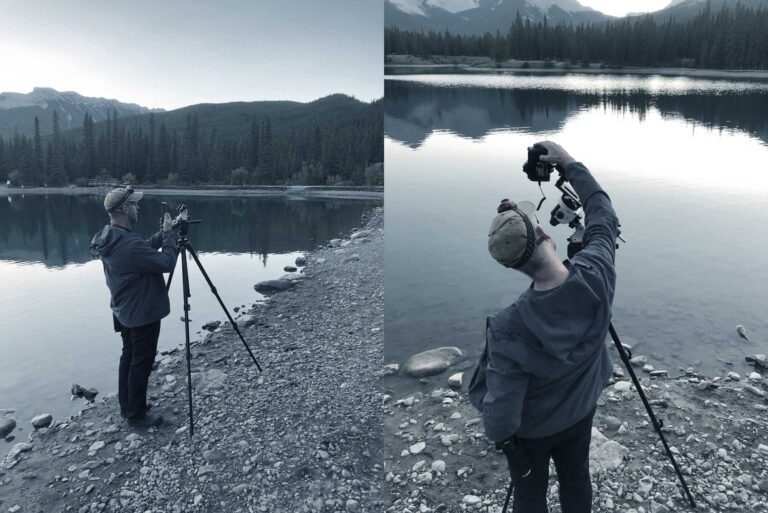
So, I’m configuring each camera body, lens. mount, and tripod combination to handle three unique approaches to shooting and capturing the lunar eclipse. I currently have three Nikon camera bodies and a number of lenses at different lengths to capture specific targets or views. Each camera and lens combination selected is intentional based on how they handle light and distance.
A long lens captures detail on the Moon’s surface
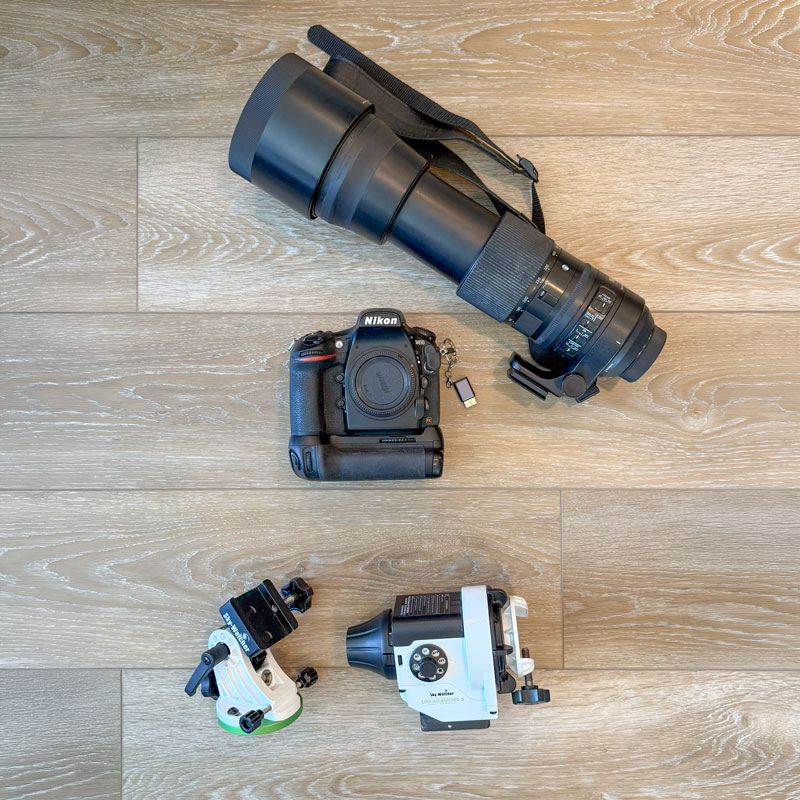
For tighter close-up detail work I’ve selected a Nikon D810 (Ha mod) with a Sigma 150–600mm f/5.6 Contemporary lens. No teleconverter. At 500-600mm the Moon fills the frame well enough, and I’d rather crop a bit than lose sharpness or f-stops.
At the beginning, exposure is similar to any full Moon. Think fast shutter speeds and low ISO. A typical starting point might be 1/500 at f/8, ISO 100. As the shadow moves in, brightness drops steadily, so you can’t leave your settings untouched. Watch the bright portion of the Moon and protect those highlights in your histogram first.
Once totality begins, the light shifts dramatically. The Moon no longer reflects direct sunlight. It’s lit only by light passing through Earth’s atmosphere (filtered). What was a perfect fraction of a second exposure in full light can become a half second or more (you don’t want to exceed 1 second because the moon moves fast – it will blur). That’s when lens stability becomes critical. Be sure to use a solid, heavy tripod (consider weighting it) and use an intervalometer or remote trigger for exposures. Avoid touching the camera if at all possible…at 500mm+, even small vibrations show.
Bracketing helps here. If half a second looks right, try a full second and 1/3 second as well – and increase ISO as far as 2500. Watch that you aren’t introducing too much noise. The red phase can be quite dark, and atmospheric turbulence means one frame will often be sharper than the next. Bracketing usually means touching the camera. (Yes, I said don’t touch it, but sometimes it’s unavoidable.) Allow time for the camera to settle before triggering the shutter.
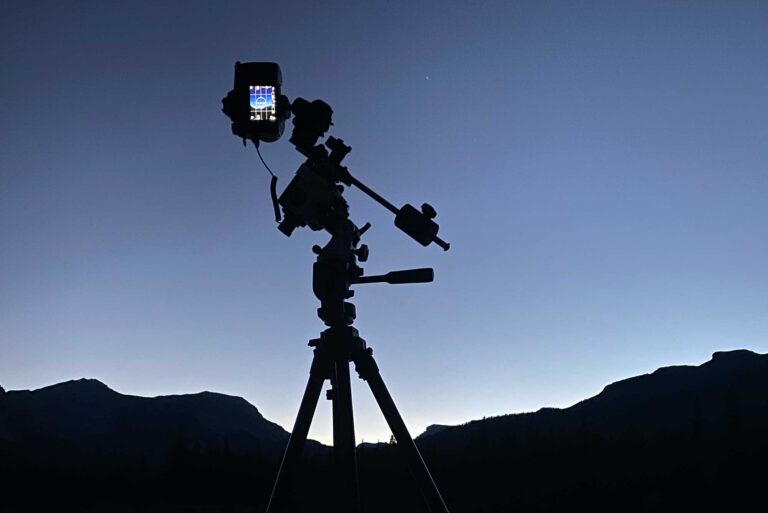
To stay precisely aligned at longer focal lengths, I recommend adding a star tracker between the tripod and the camera for this setup. My Sky-Watcher Star Adventurer has a lunar tracking mode, which compensates for the Moon’s movement. At 500mm and beyond, that stability matters a lot. It keeps the Moon centred longer, helping to avoid mount adjustments. For my tracker, shutter control can be done via an app so I can trigger exposures without touching the camera. Still, I need to manually adjust aperture and ISO, so can’t completely get away from touching it.
A mid-range lens shows how the Moon sits in the landscape
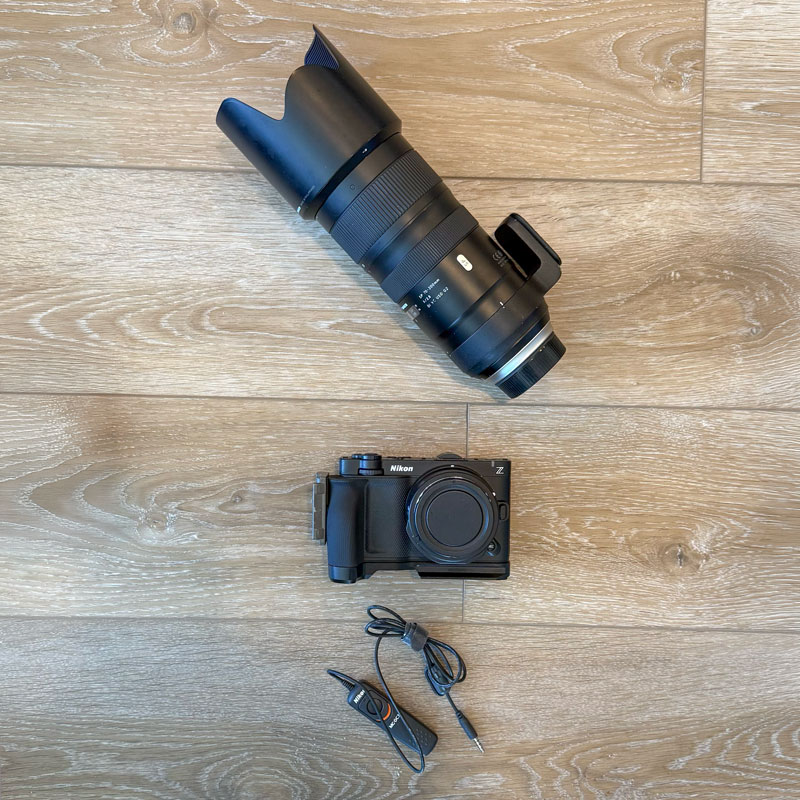
At mid-range, I’m running a Nikon Zr body with a Tamron 70–200mm f/2.8 (FTZ II mount adapter). This focal length shows the Moon in relation to the horizon which is ideal for building a lunar phase progression composite later.
As the Moon lowers, its possible you’ll be shooting through thicker atmosphere. That changes things again. Contrast drops. The red can deepen. Edges soften slightly. That’s normal. If you want to build a composite image in editing, take one frame every few minutes and keep the spacing consistent. You don’t want to change focal length mid-sequence. You do want to shoot several images so you can pick through them for the best exposures.
My Tamron lens handles that shift well. At mid-range focal lengths, the subtle softening reads as mood rather than a technical issue. If your goal is a clean phase progression composite, consistency matters more than absolute sharpness. Lock the framing, maintain interval spacing, and resist the urge to refocus unless you see obvious drift. (Note that at the time of this writing, the Nikon Zr is so new, it doesn’t have an intervalometer option yet…so, my only option is the tethered shutter release).
A wide lens records the transition from night, through eclipse, and into the morning (known as a Holy Grail sequence)
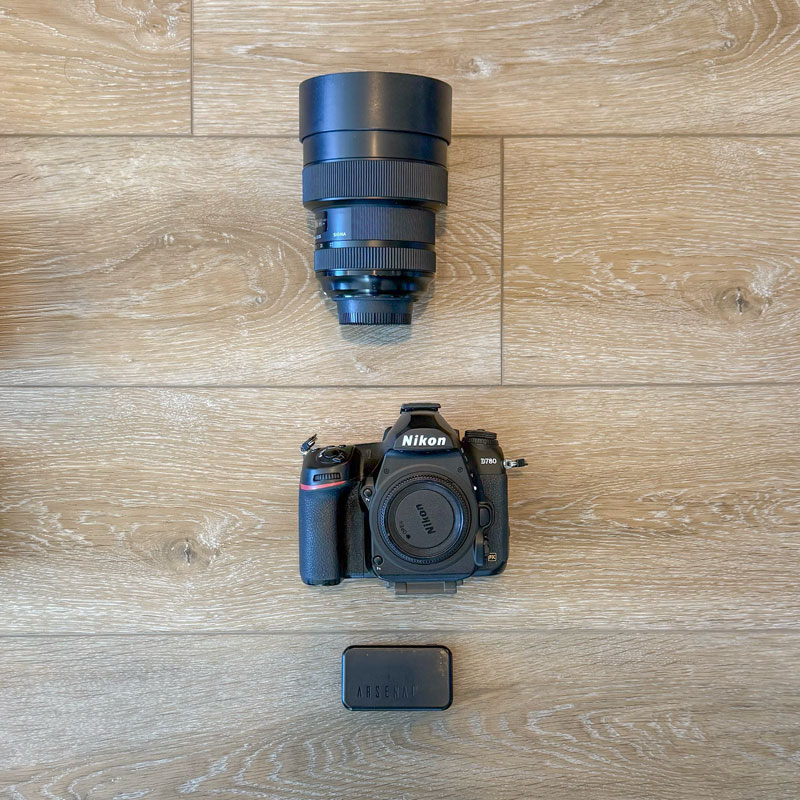
For the broader scene, my camera of choice is the Nikon D780 with a Sigma 14–24mm f/2.8, set around 20–24mm. I intend to have this camera run continuously. It is my go to for the holy grail sequence for a few reasons…it handles dynamic range exceptionally well, has proven reliable in all weather, and it seamlessly plugs into my other gear.
A wide angle isn’t about getting lunar detail. Rather, its about context. At the beginning, it shows the bright full Moon before it shifts to become a red Moon suspended in a dark sky, then back to full Moon again. As dawn approaches, the sky brightens quickly and the contrast between Moon and background drops. You’ll need to shorten shutter speed and lower ISO as the sky lightens. Near sunrise, the Moon can fade into the blue. The only way to achieve this is shooting a Holy Grail time lapse.
Traditionally, a Holy Grail is one of the most difficult time lapses to capture. Doing so requires constant manual camera adjustments between shutter releases that might be just seconds apart – each one being a perfect exposure. For this attempt, since I’ve got 2 other cameras to manage at the same time, I’ve opted to bring another device out of my bag…the Arsenal 2. Once set up, this device automatically makes the fine camera adjustments for me so I don’t need to. The camera is then able to run on it’s own, freeing me up to focus on manual triggers, manual adjustments, and bracketing exposures on the other two setups which are much more critical.
One camera, limited lenses? No problem. Shoot with what you have.
If you’re thinking about your own gear, know that the principles matter more than the brands:
A lunar eclipse isn’t just a red Moon. It’s a slow transition of an object facing varying light conditions, moving through our atmosphere. When you plan for that progression, you’ll come home with a story instead of just a single frame. But even if you only get that, it’s still a big accomplishment, because shooting the Moon is not easy.
Bonus: camera settings
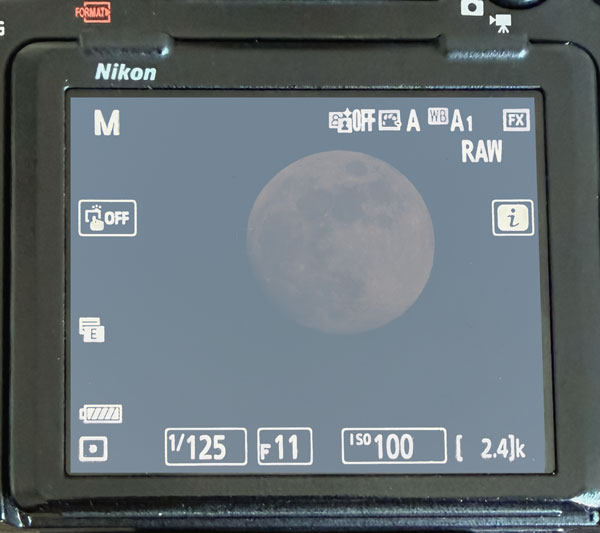
First, always use Spot Metering on the moon so the dark sky doesn’t trick your camera into overexposing. Keep your shutter speed faster than 1/125s to prevent motion blur, and use Manual Focus via your LCD screen to lock in the craters.